


53 years on the front lines
The Rape Crisis Center of Central New Mexico has been serving survivors of sexual violence since 1973, making it one of the longest-running rape crisis centers in the state. Today, RCCCNM is also the largest, providing free services to survivors of sexual assault, sexual abuse, sex trafficking, and some domestic violence across four counties.
The work is relentless. In one recent five-day stretch, the team responded to 15 medical accompaniment cases at area hospitals. Their 24-hour hotline runs 365 days a year, staffed by trained volunteers and staff. Every service they provide is free. Every call, every forensic exam accompaniment, every hour of case management.
RCCCNM recently joined forces with the Albuquerque SANE Collaborative and now also provides forensic medical exams directly to survivors, bringing crisis intervention, advocacy, counseling, and SANE services together under one roof.
"No survivor should ever have to go through this by their self. I can't imagine anyone coming forward and having to go through all the steps that it takes, from getting the courage to finally call the hotline, to going in and getting the sexual assault forensic medical exam. I just can't imagine making someone go through that by themselves."
Kim Stark, Executive Director
StriveDB is cloud-based case management software built specifically for victim service organizations, including rape crisis centers, domestic violence shelters, and family justice centers. The Rape Crisis Center of Central New Mexico (RCCCNM), the largest rape crisis center in the state, uses StriveDB for crisis hotline call logging, SANE medical accompaniment tracking, clinical session note approvals, volunteer timesheet management, and one-click VOCA grant reporting. The platform was developed over two years in direct partnership with RCCCNM's frontline staff to ensure trauma-informed design.
When the database couldn't keep up
Before StriveDB, RCCCNM used a different database. Staff were manually adding up numbers for reports. Volunteers couldn't enter their own data. And when grant reporting deadlines hit, pulling what they needed was a scramble.
"We had a database. It just didn't do the amount of work that StriveDB does for us. We were still having to add numbers up. We didn't have where we could just hit a button and it would generate a report."
Kim Stark, Executive Director
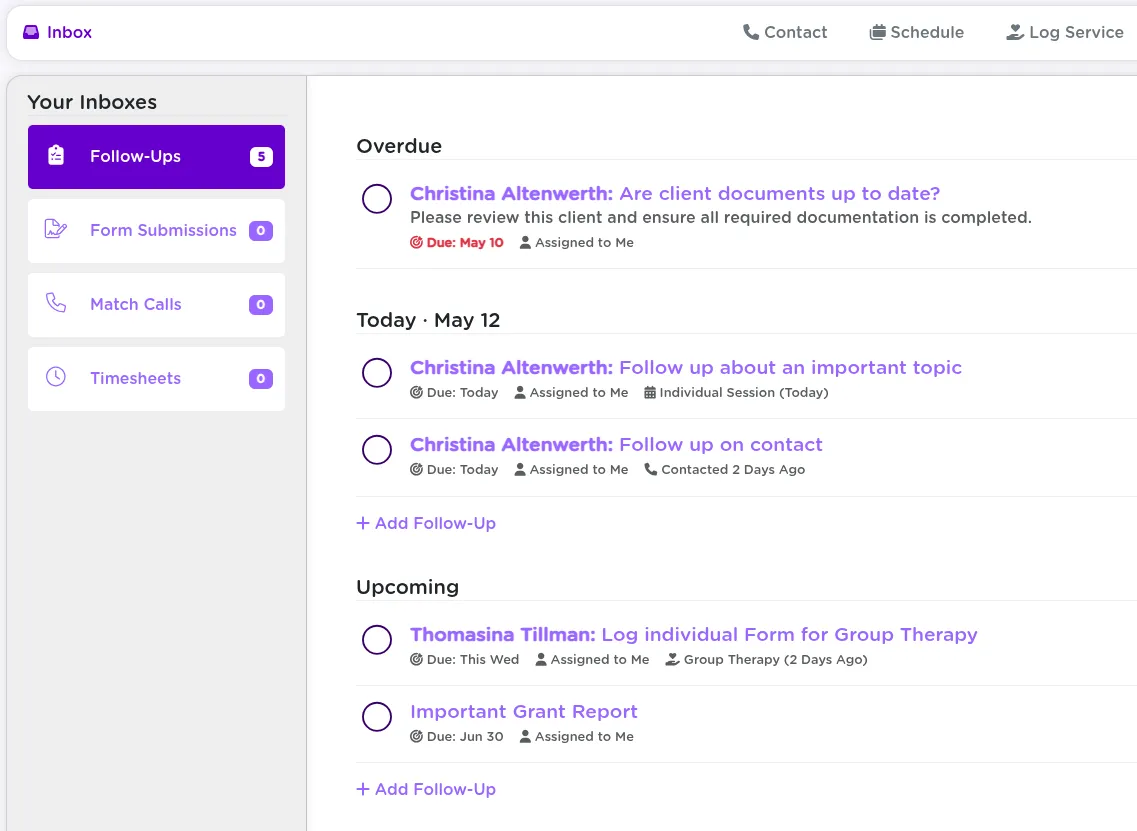
Sofia Chavarria, RCCCNM's volunteer program director and a former case manager, saw the limitations from both sides. Volunteers who staffed the 24-hour hotline had no way to log their own calls. Their hours had to be entered by someone else. Tracking frequent callers, a real operational concern for a high-volume crisis line, wasn't possible.
"With the past database, our numbers were all over the place. They had no access, and now it's just a very big open door."
Sofia Chavarria, Volunteer Program Director
Kim put it simply: "I just wanted to work smarter, not harder."
Emily Hicks, RCCCNM's clinical director and a practicing therapist at the center, experienced the limitations firsthand. As the person responsible for reviewing every clinician's session notes, she felt the friction daily. "The word I would use is clunky," she said. "There was a lot of spaces where we had to go around to get a job done. There was a lot of steps involved. And so it took substantially more time to get pretty basic things done."
Why the existing options didn't fit
What RCCCNM needed was straightforward: a modern, web-based platform that any staff member or volunteer could use, with accurate grant reporting without fighting the software to get there.
The available options didn't fit that description.
Osnium is common among New Mexico centers, and many of RCCCNM's peer organizations run on it. But it's an older Windows desktop application, and RCCCNM needed something modern, web-based, and accessible to every staff member and volunteer without specialized software installed on a specific machine.
Bonterra Apricot is the biggest name in nonprofit case management, but it's a general-purpose platform where even basic VOCA reporting can require a third-party consultant to configure. Pricing isn't published, and for a 23-person grant-funded organization, the cost and complexity weren't justified when the goal was something the whole team could use on day one. (See our full comparison.)
EmpowerDB's flagship claim is zero-knowledge encryption, but both the claim itself and the tradeoffs it introduces raised concerns for a 24/7 center where staff need reliable access at any hour.
Vela is built for DV/SA programs and has solid grant reporting. But it fell short in a few important ways: RCCCNM runs a full counseling program and needed dedicated clinical tools that Vela doesn't offer; the reporting wasn't configurable around NMCSAP's specific monthly data collection format; and after talking with other centers about their experiences, the team came away with serious concerns about how practical it would be for a busy team to use.
None of these gave RCCCNM what they were looking for: something purpose-built for their work, flexible enough to handle NMCSAP's reporting format alongside VOCA and other funders, and simple enough that the whole team could use it without specialized training.
Kim put it simply: "I just wanted to work smarter, not harder. I didn't want to have to spend a lot of time adding up those numbers manually."
Not just a customer. A partner.
StriveDB's team worked one-on-one with RCCCNM through every stage of implementation, from initial user sketches and UI/UX flows to the finished platform. Kim and her team served as subject matter experts, bringing decades of frontline experience to every design decision. The goal was to build case management software that solved RCCCNM's specific needs while being broadly useful to rape crisis centers and other victim service organizations nationwide.
That partnership shaped StriveDB at a fundamental level. RCCCNM's team ensured that every workflow was trauma-informed, that the system avoided revictimization, protected survivor privacy, and gave advocates the tools they actually need rather than the tools a software company assumed they'd want. The permission structures, the way call data connects to survivor records, the separation between volunteer access and clinical access: all of it reflects guidance from people who understand what's at stake when a survivor's information is in a database.
Emily noticed the difference. She's worked with multiple databases across her career, and none were built for this kind of work. "You all have been very responsive and I feel like you've listened to what we have needed and tried to implement those things as quickly as we can. It's been great."
This is how StriveDB works with every organization it serves, whether it's a rape crisis center, a domestic violence shelter, or a family justice center. The team doesn't hand you a blank platform and wish you luck. They learn your workflows, configure the system around your needs, and stay accessible after launch. RCCCNM was where that process started. It's also how every new organization is onboarded.
The switch: terrifying at first, then transformative
Even with that partnership, switching to a new system was nerve-wracking. Any organization that's changed databases knows the anxiety. RCCCNM was no different.
"I would not want to have any other database."
Sofia Chavarria, Volunteer Program Director
Sofia, who manages the volunteer program, was anxious about how her team would adapt. "We were beyond terrified getting a new database because anything new is scary. But I would say thanks to you guys for making it not as scary, because I would not want to have any other database."
Kim credited StriveDB's hands-on support for making the transition manageable. "Every time we had a problem, we could call and you were accessible. Even if it was just through email, you would problem solve it, call back, or figure out a way."
Staff adoption followed. "Everybody loves it," Kim said. "I promise everybody loves it. It's an adjustment because any time you're learning something new, obviously, you've got that learning curve. But once you figure it out and you can see how versatile it is, it really does help."
Emily, who managed the transition for the clinical team, found that short weekly meetings were enough to get her clinicians comfortable. "We would have a meeting once a week, just for about a half hour to an hour. Any updates that came through, we would show. But it was pretty intuitive and we just encouraged people to look around and try things out."
Her verdict on the switch: "Hands down, would definitely do it again."
One database, two offices, every service connected
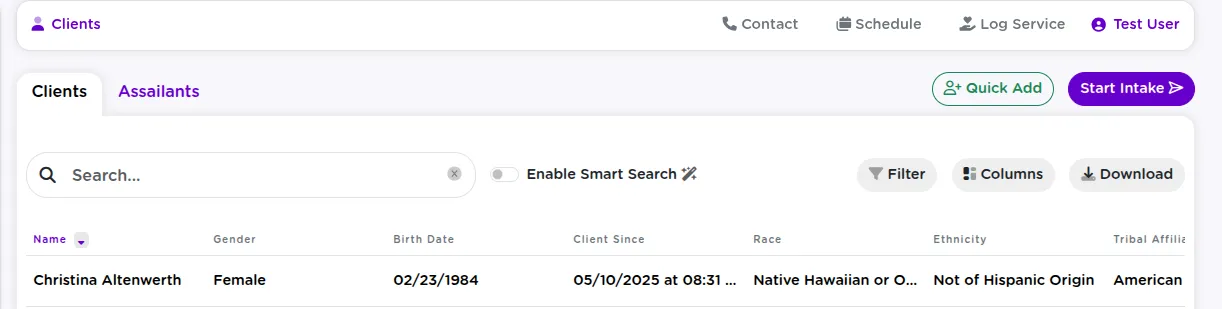
RCCCNM operates from two locations: a main campus on Candelaria Road and a second office at the Albuquerque Family Advocacy Center downtown. Keeping both sites connected around the same survivors and the same cases was a persistent challenge.
StriveDB changed that.
"It kind of puts everything, all the information in one place so whoever picks it up can run with it. If a case manager is picking up that case, they can look at it and say, this person's in distress. They called and they were suicidal, where do we go now? That's really helpful to me because we have two different offices, but we have to keep those two connected because all of our services are interconnected."
Kim Stark, Executive Director
For the counseling team, this means they can see what advocacy work has already been done. For advocates, it means they know if a survivor has been in contact before. No one starts from zero.
Volunteers who can finally do their own work
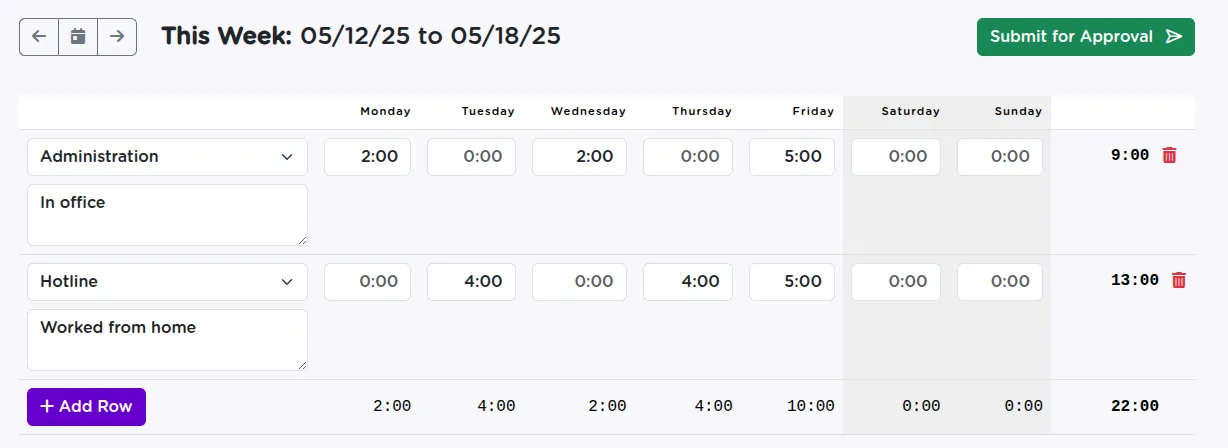
RCCCNM's volunteer advocates are the backbone of the 24-hour hotline. Managing their schedules, training requirements, and hours is a job in itself, and it used to require Sofia to manually enter everything on their behalf.
Now volunteers log into StriveDB, enter their own calls, and submit their own timesheets. Sofia gets a notification, reviews and approves them, and can edit when needed.
"A lot of our volunteers kind of cut themselves short sometimes for their hours. And I'm like, you have more time. Give yourself more time. So it's been handy to be able to edit that."
Sofia Chavarria, Volunteer Program Director
StriveDB's granular permission system means volunteers can do all of this without accessing sensitive client information. Volunteers have the access they need to do their jobs, and nothing more. For an organization handling deeply confidential survivor data, that separation matters.
From post-it notes to one-click reports
For RCCCNM's counseling team, the shift to StriveDB solved a problem that had been quietly eating hours every week: the clinical note review process.
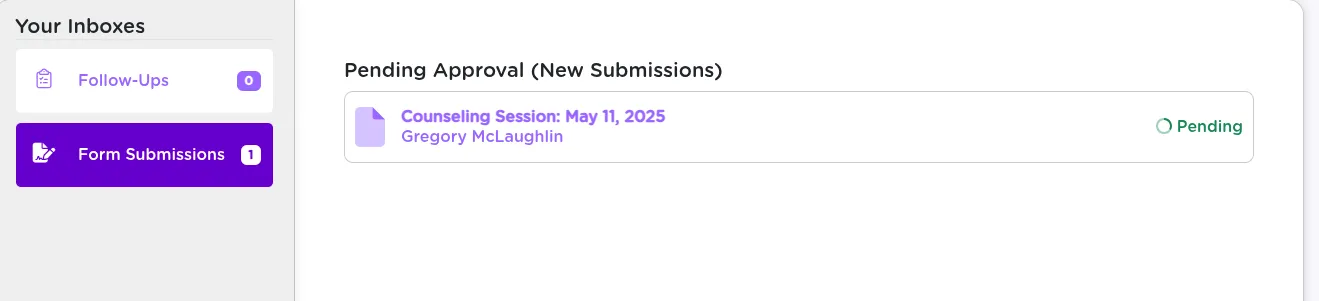
As clinical director, Emily Hicks reviews every session note her clinicians write. In the old system, there was no way to send a note back for correction. No approval workflow. No reminders. Just post-it notes and memory.
"Checking the notes for my clinicians is a lot easier. It's all in my inbox. I can send them back, which is something we didn't have before, which I love. Sometimes there's things that the clinician can catch that they missed, or I can catch it and send it to them and they can go ahead and make the correction, even if it's something as simple as a score is off. It's just really an easy fix and then can be done and just sent right back."
Emily Hicks, Clinical Director
The follow-up feature has also changed how clinicians manage their caseloads. Instead of relying on handwritten reminders, therapists can attach follow-up tasks directly to a client record: a behavioral health screening that's due, a call to return, a referral to coordinate.
"Those reminders are better for patient care because it reminds us that we need to do those things. Whereas before there was no place for those reminders. We just had to write it on a post-it basically. Relying on our own memory isn't as efficient as having a reminder."
Emily Hicks, Clinical Director
Emily has worked with multiple databases across her career. None of them, she said, were built for the specific needs of a trauma-focused victim service organization. "This is one of the ones that has been far more intuitive and just easier to use. The ability to find things and to document them. I love the layout where I'm able to see everything."
Grant reporting that meets coalition standards
Nearly 100% of RCCCNM's annual budget comes from government grants and private foundations. That means reporting isn't optional. It's existential. VOCA, SASP, VAWA, city and state grants all have their own requirements, their own timelines, and their own formats.
StriveDB includes one-click VOCA reporting on every plan, starting at $199/month. Custom funder reports are also included in the subscription, with no per-report fees.
Beyond federal reporting, StriveDB also worked directly with the New Mexico Coalition of Sexual Assault Programs (NMCSAP) to build the coalition's Sexual Assault Services Monthly Data Collection Tool into the platform.
NMCSAP is the statewide organization that leads New Mexico's response to sexual violence. The coalition coordinates funding, training, and technical assistance for a network of 16 sexual assault service providers and 14 SANE programs across the state, as well as 21 prevention programs serving 39 communities. In FY2025, that network collectively served nearly 6,000 survivors, provided close to 1,000 SANE exams, and fielded over 16,000 crisis calls. NMCSAP also operates the Interpersonal Violence Data Central Repository, which collects data from law enforcement agencies, service providers, SANEs, and courts statewide to produce annual reports that shape policy and funding decisions at the state and federal level. In recent years, the coalition has led a significant expansion of services into previously unserved rural communities, including new programs in Alamogordo, Carlsbad, Grants, and Hobbs.
Every NMCSAP member agency submits monthly data through the coalition's Sexual Assault Services Monthly Data Collection Tool, a reporting framework that unifies data definitions from VOCA, VAWA, SASP, and CYFD into a single instrument. The tool is not a simple count. It has specific rules governing which clients count as new vs. continuing, requires demographic breakdowns across age, race, gender identity, sexual orientation, disability status, and county or tribal land of residence, and separates service categories into detailed subcategories: SANE exams alone are broken into seven distinct types by age group and exam category. PREA and non-PREA advocacy are tracked separately. Outreach and prevention activities are distinguished from each other. Any organization filling this out by hand is spending hours every month interpreting counting rules and cross-referencing data.
StriveDB's team worked through those rules with the coalition to build the report directly into the platform. The system now generates the numbers in the exact format and categories NMCSAP requires, so organizations like RCCCNM don't have to manually compile, interpret, or reconcile the data themselves. The report comes out accurate on the first click.
For RCCCNM, the difference was immediate.
"It does make it a lot easier to be able to hit a button and it just generates the information that you needed for that report. The reports are so customized to what we need."
Kim Stark, Executive Director
Sofia echoed the impact from her side. StriveDB's reporting let her pull volunteer data for board presentations and even social media. "We just had an advocate that did 750 cases, which we were able to pull from the database."
For Kim, the shift was personal. "As an executive director, you have to follow those numbers and stay on top of that. To be able to connect departments within your agency has really helped make our job a lot easier."
Connecting the dots across jurisdictions
One of the reasons StriveDB was built the way it was: RCCCNM needed the ability to track offender patterns across cases. And it's working.
Albuquerque sits at the center of multiple jurisdictions: city, county, and surrounding municipalities that don't always share information with each other. RCCCNM, because it serves survivors across all of them, often holds data that no single law enforcement agency has.
"Because Albuquerque is so big, because towns don't talk to each other, sometimes those departments don't talk, but we're able to collect the data if we have a survivor."
Kim Stark, Executive Director
StriveDB's search capabilities allow advocates to identify patterns across cases that might otherwise go unnoticed. Kim described one example:
"Let's say that he writes a particular thing on their skin. We can go in and we can do a search for the wording that was used on their skin and see how many cases are connected to that. And so it does help say, okay, wait, this guy might be a serial rapist."
Kim Stark, Executive Director
In one case, RCCCNM flagged a sex trafficker in September. When the same individual resurfaced in January, law enforcement already knew the name. "They were able to get a conviction," Kim said, "which is great because he was trafficking children."
This is what happens when survivor data is organized, searchable, and connected across an entire organization. Patterns that would otherwise stay buried in separate case files become visible and actionable.
The bottom line: why RCCCNM chose StriveDB
RCCCNM helped shape StriveDB from the ground up. They're also a living example of what it makes possible: a grant-funded victim service organization doing complex, multi-program work with a lean team, where every hour spent on data entry is an hour taken away from a survivor. With StriveDB, Kim and her team spend less time wrestling with their data and more time doing what they've been doing for 53 years. Showing up for survivors when it matters most.
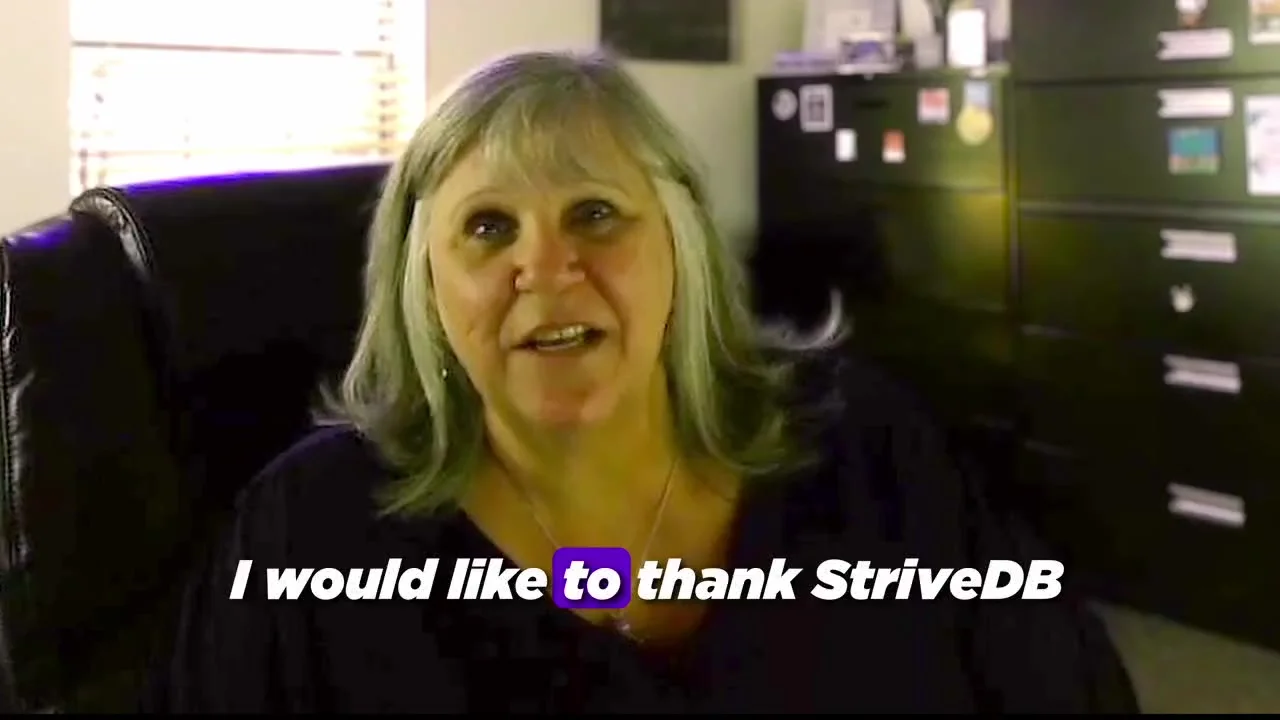
"I would like to thank StriveDB for making my job easier. To be able to connect departments within your agency has really helped make our job a lot easier. We appreciate it."
Kim Stark, Executive Director
And from Emily, a message for other centers considering a change: "Any change is kind of hard. But with this system, it was so easy to find what you need. That initial little rough patch, the learning curve, once that's overcome, it is much better on the other side."
Ready to see what StriveDB can do for your organization?
Cloud-based, trauma-informed case management for victim service providers. Plans start at $199/month.
Book a free consultationFrequently Asked Questions
What is StriveDB?
StriveDB is cloud-based case management software built specifically for victim service organizations. It is the only VSP database that combines a dedicated legal advocacy module, a clinical counseling module with measurement-based care (PHQ-9, PCL-5) and subpoena compliance workflows, one-click VOCA reporting on every plan, volunteer management, AI-powered paper form scanning, and anonymous survivor feedback surveys in one system. It serves rape crisis centers, domestic violence shelters, and family justice centers with transparent pricing starting at $199/month. StriveDB was developed over two years in partnership with the Rape Crisis Center of Central New Mexico.
Does StriveDB work for domestic violence shelters and family justice centers?
Yes. StriveDB was designed for the full range of victim service organizations, not just rape crisis centers. The platform handles intake, service tracking, follow-ups, safety planning, and grant reporting out of the box. Optional modules add support for legal advocacy (protective order tracking, police reports, SART tools), clinical counseling (session notes, PHQ-9, PCL-5, approval workflows), and AI-powered paper form scanning.
How much does StriveDB cost?
StriveDB's pricing is transparent and published. Plans start at $199/month (Basic, up to 2 staff) and go up to $1,250/month (Premium, up to 100 staff), with custom pricing for multi-site and coalition deployments. VOCA reporting is included on every plan, including Basic. Optional modules for counseling, legal advocacy, and AI-powered data entry are $100/month each on Team plans and above. View full pricing.
Does StriveDB include VOCA reporting?
Yes. One-click VOCA reporting is included on every StriveDB plan, including the $199/month Basic plan. StriveDB has also built state coalition reporting formats directly into the platform, including the NMCSAP Sexual Assault Services Monthly Data Collection Tool used by New Mexico's 16 sexual assault service providers. Custom funder reports for other grants (VAWA, FVPSA, state and local funders) are included in the subscription on Team and Premium plans, with no per-report fees.
How long does it take to switch to StriveDB?
Timelines vary depending on the size and complexity of your organization. On Team plans and above, StriveDB's team configures the system for you, including building your forms, permissions, and workflows. Data migration is included for most organizations at no additional cost. RCCCNM's clinical team found that weekly 30 to 60 minute training meetings were enough to get staff comfortable within the first few weeks.
How does StriveDB protect survivor data?
StriveDB is HIPAA-compliant, VAWA-compliant, and has completed an independent security audit by Accorian, including a full penetration test with no medium or higher vulnerabilities found. Multi-factor authentication is required by default on all plans. The platform uses granular role-based permissions designed specifically for VSO organizational structures, separating volunteer, advocate, clinical, and administrative access. All data is encrypted in transit and at rest.