
When your center evaluates a case management system, features and pricing often dominate the conversation.
But security should really come first.
SA, DV, and Family Justice centers store safety plans, protective orders, forensic documentation, immigration details, and confidential communications. The system you choose must be built to protect that information.
And if your center receives federal funds from VOCA, VAWA, or FVPSA, then you are actually required by law to choose a database that adheres to strict confidentiality requirements. Many vendors do not meet those requirements.
Before you sign a contract with a database vendor, here are some key questions you should ask:
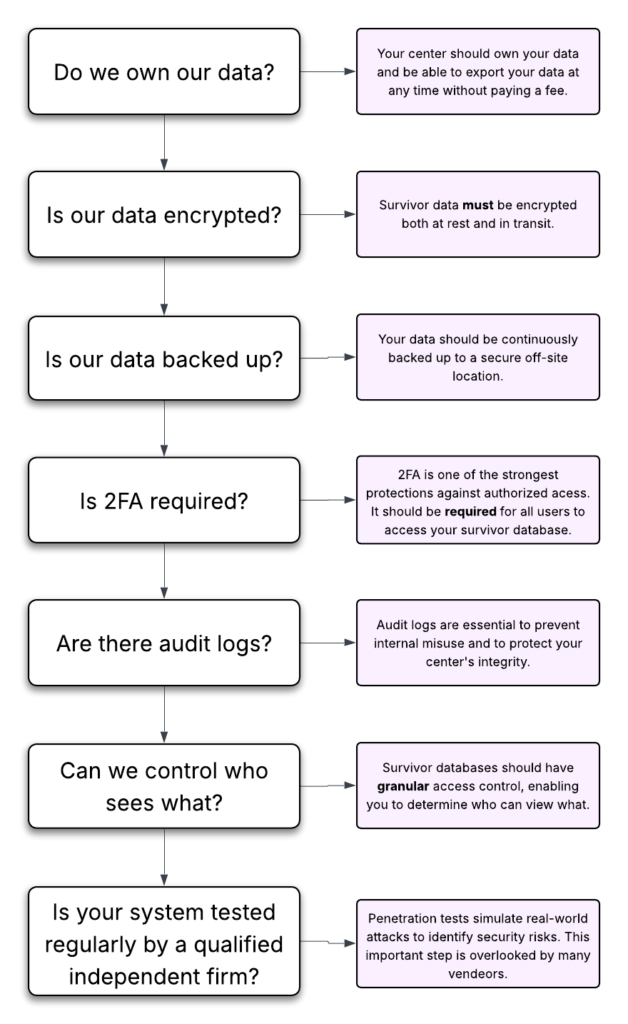
Question 1: Do We Own Our Data?
This is foundational. You would be amazed how many database vendors think that they own your data and will charge you exorbitant fees to get your data back out. Worse still, many vendors will use your data for marketing purposes or share it with undisclosed third-party providers.
So ask directly:
- Do we retain full ownership of our data?
- Will you ever share our data with third parties?
- Will you use our data for marketing purposes?
- Will we pay a fee to retrieve our data if we change vendors?
It is critical that survivor data is not being shared, sold, or repurposed.
You should not have to pay a penalty to access your own records or feel locked into a system because leaving is expensive or technically difficult.
Your center should own its data — fully and clearly.
Question 2: Where Is Our Data Stored?
Security is not just about protection from hackers. It is also about protection from data loss and internal misuse.
Ask vendors:
- Do you encrypt all survivor data in transit and at rest?
- Do you regularly back up data to an off-site location, and do you encrypt those backups?
- Will you store our data in a modern cloud-based system or an on-premises server?
It might seem unintuitive, but cloud-based systems are actually a better choice. Hard drives fail all the time. The cloud offers redundancy and state-of-the art physical access controls to keep your data safe from theft and loss.
You should understand both the technical protections and the human safeguards in place.
Question 3: Do You Require Two-Factor Authentication?
Requiring two-factor authentication (2FA) might be the single most important thing you can do to protect the victim data in your database from unauthorized access.
2FA is a simple security measure that asks users to enter a code sent to their phone or device to verify their identity while logging in. This is dramatically more secure than passwords alone because even if someone steals or guesses a password, they still cannot access the account without that second code.
Be sure ask:
- Does your system require 2FA for all users?
- Can users turn it off?
- What 2FA methods do you support?
If you do not require 2FA for all users, that introduces a significant governance risk. Survivor data should never depend on voluntary security settings.
If you’re unsure what 2FA is or why it’s so important, check out our guide on two-factor authentication.
Question 4: Can We Control Who Sees Survivor Data?
Victim service organizations require layered confidentiality.
Ask:
- Can we restrict access by role?
- Can our volunteers view victim data?
- Can we add restrictions directly to individual survivor records?
Consider this scenario:
What if someone who works at your center is also a survivor whose data is in your database?
How does the system prevent unauthorized staff from viewing that record?
Granular, role-based permissions — and the ability to restrict specific records — are essential.
Question 5: Do You Have Audit Logs?
Audit logs track activity inside the system.
Ask:
- Can we see who viewed a record?
- Can we see who edited or deleted data?
- Can we track exports?
The risk is not only external attackers. It is also internal misuse.
If a malicious staff member deletes data, could you prove to a court, funder, or law enforcement agency what happened?
Audit logs provide accountability and evidence that no one has impromperly altered your data.
Question 6: Can We Disable Accounts?
You know far too well that staff turnover is extremely common in this line of work. You must have the ability to disable accounts when staff members and volunteers leave the organization or no longer need access.
Ask:
- Can administrators disable accounts immediately and without contacting support?
- Can we revoke access in real time?
- Does revoking access also terminate current active sessions?
Delayed offboarding is one of the most common vulnerabilities in small organizations.
Question 7: What If There Is a Data Breach?
Every vendor should have a documented data breach plan.
Ask:
- Do you have a written breach response process?
- How quickly would we be notified?
- Do you carry cybersecurity insurance?
- Have you undergone independent security testing or audits?
You should never be learning about a breach response process for the first time during an actual breach.
Question 8: Do You Have Regular Security Assessments?
Ask:
- Do you conduct regular penetration tests?
- Does an independent third-party security firm conduct your security audits?
- How often do you perform security assessments?
- How do you document and remediate findings?
A penetration test simulates a real-world attack to identify weaknesses before someone malicious does. Independent testing helps verify that security protections are not just internal claims.
How Strive DB Keeps Your Data Secure
We built Strive DB specifically for the unique needs of victim service centers, with survivor confidentiality as a core design principle. Here is how Strive DB meets the security standards outlined above:
- You own your data
Your center retains full ownership of its records. We do not sell your data or use it for marketing purposes. There are no punitive fees to export your data if you choose to move to another system, and you can export data at any time. - Cloud-hosted, professionally managed infrastructure
Strive DB is cloud-based, reducing the risks associated with on-premise servers such as hardware failure, theft, or missed security updates. - Encryption at rest and in transit
We encrypt your data while being transmitted and while stored on servers. We also continuously backup data to offsite locations, and we encrypt our backups. - Strict internal access controls
We tightly restrict access to production systems with strong security measures. - Mandatory two-factor authentication (2FA) and strong password requirements
We require 2FA by default for all users, and we enforce minimum password length and complexity standards. - Granular role-based permissions and immediate account disabling
Centers can control exactly who sees what — including restricting sensitive records. Administrators can revoke access instantly when staff leave without opening a support ticket. - Detailed audit logs
We log all record views, edits, and key actions in a secure audit log, supporting accountability and documentation. - Independent security validation
Strive DB undergoes annual independent penetration testing and has completed a third-party security audit conducted by Accorian, a leading cybersecurity firm. - Documented breach response plan and cybersecurity insurance
We follow a formal incident response process and maintain current cybersecurity insurance.
Security is not an optional feature. We built security into the foundation of the platform.
Choosing a database is not just a software decision.
It is a confidentiality decision, a governance decision, and a risk management decision.
These questions help ensure survivor data is treated with the seriousness it deserves.