


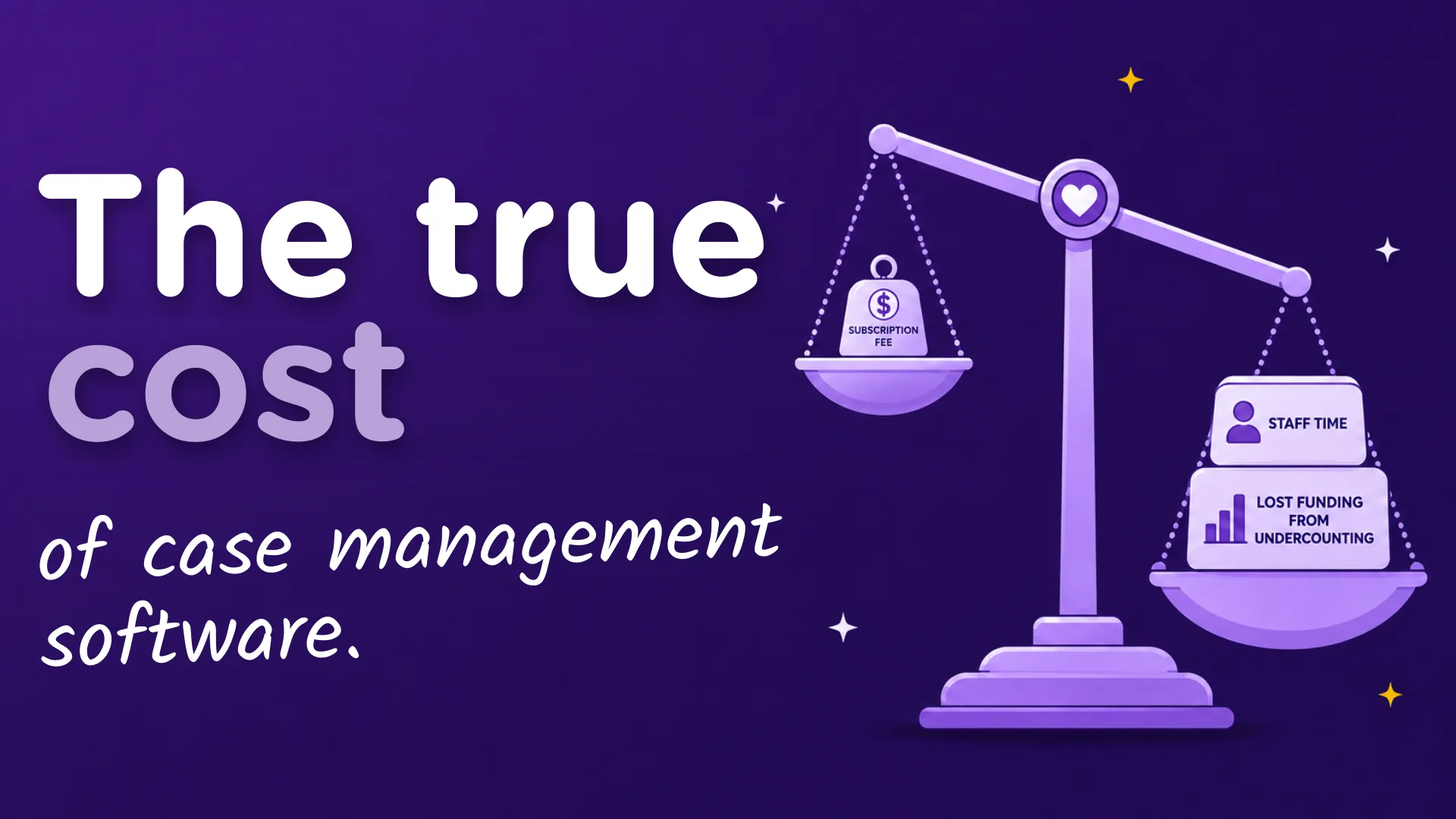
Quick answer: The monthly price of a case management system is the smallest part of what it costs your domestic violence shelter, rape crisis center, or family justice center. The bigger numbers are the staff hours lost to manual data entry and reporting, and the grant dollars lost when your center undercounts the survivors it serves. A more capable system, even one that costs more up front, can leave you with more money in your operation. Here is how to run that math for your own center.
What does case management software for a domestic violence shelter actually cost?
Published prices for case management software built for victim service providers run from a few hundred dollars a month to a few thousand. StriveDB lists its plans openly: $199 a month for Basic, $520 for Team, $1,250 for Premium. Most of the products we get compared to don't publish their prices at all, which tells you something about how the buying process usually goes.
But the sticker price is the smallest of three costs you actually carry.
The first is the license, the number on the invoice. The second is the staff time the system consumes, every hour your advocates spend typing the same information twice and every hour your reporting takes. The third is harder to see: the funding accuracy the system supports or quietly undermines. A system that makes your numbers look smaller than the work you actually do costs you in grant dollars, and that cost never shows up on an invoice.
When you add all three together, the cheapest plan is often not the cheapest system. That is the case we want to make here, with real numbers you can check.
If your center is tight on money, or you just lost funding, start here
When the budget tightens, the first instinct is to look at services and staff. That is the most painful place to cut, and for most centers it is also the wrong place to look first.
The funding pressure on domestic violence shelters, rape crisis centers, and family justice centers is real and it is broad. The federal Crime Victims Fund, which sits behind most VOCA dollars, has dropped more than 70 percent since 2018, including a roughly 40 percent reduction since 2023, according to the Urban Institute. The VOCA cap fell from $4.4 billion in 2018 to $1.2 billion by March 2024, per reporting from Stateline. In NNEDV's most recent survey, 54 percent of programs said they would close within six months if federal funding were cut in half. If your center just absorbed a cut or lost a funder, you are not an outlier. You are in the middle of the sector.
So before you touch services, look at what your current system costs you in two places you can actually recover: the funding you are leaving on the table because your numbers are low, and the hours your team loses to manual work.
Are you undercounting the survivors your center serves?
Many shelters and centers report fewer survivors and fewer services than they actually deliver. The gap is rarely carelessness. It comes from a handful of specific, fixable mistakes in how the numbers get counted, and once you see them you tend to recognize your own center in at least one.
Here are the three we see most often.
Counting "new" clients wrong. Under the OVC Victim Assistance performance measures, you count a person as "new" only the first time you serve them under a subaward, regardless of how many services they receive. You still report them in the periods after that, just not as new. The part centers miss is that "new" is keyed to the subaward, not the calendar year. If your subawards run a year at a time, that lines up with an annual cycle and each survivor is counted as new once per award. But if you hold a multi-year subaward, a survivor you have served for years is "new" only once for the whole award, not every year, and that is exactly where centers slip. (You may have heard this described as a fiscal-year reset. That was the language in OVC's older guidance; the current Subgrantee Data Report, revised June 2025, ties the count to the subaward, so check your own practice against the current version.) Centers that provide ongoing, multi-year support are the most likely to get this wrong, and the error almost always runs toward undercounting.
Leaving services uncounted. This is the big one. OVC's reporting groups direct services into five categories: information and referral, personal advocacy and accompaniment, emotional support or safety services, shelter and housing services, and criminal or civil justice system assistance. Within those categories, you report the number of times each service was provided. Every referral, every crisis-line call, every time an advocate explains how the justice system works, each of those is a service that counts. If your team is providing them but not logging them, your center looks like it is doing less work than a comparable center down the road that logs everything. Funders see those numbers side by side.
Demographic accuracy, especially race and ethnicity. OVC uses a single combined race and ethnicity field, collected only for new individuals, and each person is counted in exactly one category. Someone who reports more than one race goes in "Multiple Races." There is also a real difference between "Not Reported," which means you collect the data but the person didn't give it, and "Not Tracked," which means your system can't capture it yet. Mixing those up is one of the most common accuracy errors, and it is exactly the kind of thing a funder notices.
None of this requires working harder. It requires a system that captures each service as it happens and rolls it into the report for you, so the number that reaches your funder reflects the work your team actually did. In StriveDB, every service an advocate logs flows into the reports. And if you have a backlog of paper intake forms, our AI case importer, available as an add-on module, can pull that history into the system so it gets counted too.
Why accurate numbers protect your funding
Software does not win you a grant. Let's be clear about that up front, because anyone who tells you otherwise is selling something. What accurate, well-documented numbers do is strengthen the case you make for every renewal and every new application, and they protect you when a funder asks you to back the numbers up.
And funders do ask. Federal rules require you to keep the source records behind your reported counts, your statistical records, for at least three years and to produce them on audit, under 2 CFR 200.334. The state agency that administers your VOCA funds is required to monitor you and validate the statistics you report, under 28 CFR 94.106. This is not theoretical. The DOJ Office of the Inspector General has issued findings against state agencies for performance data that wasn't validated or supported, including audits of victim assistance grants in New Jersey and New York.
Here is what that means on the ground. If your reported numbers don't match your records, or you can't produce the records at all, the problem doesn't stay between you and one funder. Coalitions and funders talk. Trust erodes. A center that can't stand behind its numbers becomes a center that gets passed over for the next round, and entire service lines can disappear that way. Every center has to justify its purpose and show it is the right one to deliver the services it delivers. Your data is how you make that case. Accurate data makes it well.
What is an advocate's time worth?
Your staff's time has a dollar figure, and it is higher than the salary on the offer letter. To value the hours a system gives back, you need the fully loaded cost of an hour, which includes payroll taxes, health insurance, retirement, and paid leave on top of the wage.
The standard way to get there is to multiply base pay by somewhere between 1.25 and 1.4. The Bureau of Labor Statistics puts benefits at roughly 30 percent of total compensation, so that multiplier is conservative and realistic. Here is what it looks like for the three roles whose time a case management system most affects.
| Role | Typical base pay | Loaded multiplier | Loaded cost per hour |
|---|---|---|---|
| Front-line advocate | About $45,000 | 1.3 | About $30 |
| Grants or compliance manager | $64,000 to $80,000 | 1.3 | About $44 |
| Data or evaluation analyst (statistics background) | $65,000 to $90,000 | 1.3 | $48 to $50 |
The advocate figure draws on BLS data for social and human service assistants, which puts the median around $45,000, with nonprofit pay tending toward the lower end of the range. The analyst figure reflects what nonprofit data and evaluation roles that require a statistics background actually pay. These are the numbers to hold in your head for the next two sections, because they turn "hours saved" into dollars.
Will a case management database actually save my staff time?
Yes, though the honest answer is that the size of the savings depends on your center and how it works today. We are not going to hand you a number we can't stand behind.
What we can tell you is where the time goes now. Front-line staff in comparable fields spend a large share of their week on documentation and data entry. A Colorado workload study of caseworkers found documentation and administrative tasks taking up anywhere from a quarter to three-quarters of their time, and social work research has repeatedly put it around half. Those studies come from adjacent fields rather than victim services specifically, so treat them as the shape of the problem, not a precise measure of your center. The shape is consistent: a lot of skilled time goes to typing.
Other systems in this space claim time savings in the range of 25 to 75 percent on documentation and reporting tasks. Those are vendor figures, so weigh them accordingly, but they point at something real. StriveDB approaches the same problem in two concrete ways. The report catalog, included on every plan, turns reporting that used to take hours into something closer to a click. And the AI case importer, an optional add-on module, pulls information off paper intake forms so advocates aren't retyping it. The question isn't whether a good system saves time. It's how much, for your team, which is a question you can actually answer with the break-even math below.
How do I save time on VOCA reporting?
VOCA reporting is the most repetitive, deadline-driven task most centers do, which makes it the clearest place to win back an expensive person's hours. StriveDB generates VOCA performance reporting in one click, on every plan, including the $199 Basic tier.
Consider what that task looks like by hand. VOCA performance data is due quarterly through the PMT, plus an annual report at the end of December. When the federal government estimated the burden of this reporting, it put the range at roughly 1 to 70 hours per reporting body, with a median around 20, though that figure sits at the state level and predates the current online system. At the center level, the people we talk to describe pulling a single report as a multi-hour job, repeated every quarter. One published account from a center using another system described cutting a report that took six to eight hours down to one or two.
Now put a wage on it. If the person running your reports is a data or evaluation analyst at roughly $49 an hour loaded, and reporting eats even ten hours a month, that is close to $6,000 a year in one person's time spent assembling numbers your system could assemble for you. That is real money, and it is money you are spending whether or not you ever see it itemized.
So how do I figure out if it's worth it for my center?
Run a break-even check. It takes about two minutes and it works for any system, not just ours.
- Take the system's annual cost.
- Divide it by your staff's loaded hourly cost.
- The result is the number of hours the system has to save in a year to pay for itself.
- Divide that by your headcount and by about 50 weeks, and you get the hours each person would need to save per week.
- Ask yourself: given how my team spends its week, is that realistic?
Here is what that looks like at three real price points.
| Scenario | Annual cost | Loaded rate | Hours to break even | What that means |
|---|---|---|---|---|
| Team plan, 20-person domestic violence program | $6,240 | $30 (advocate) | About 208 hours/year | About 4 hours a week across the whole team, or roughly 12 minutes per person per week |
| Basic plan, two-person family justice center | $2,388 | $37 (blended: advocate and manager) | About 65 hours/year | About 1.25 hours a week between two people |
| Team plan, reporting time | $6,240 | $49 (analyst) | About 127 hours/year | About 2.5 hours a week of an analyst's reporting time |
A couple of honest notes about these. They are illustrative models built from real wage and pricing figures, not measured results from your center. The reporting scenario is the most sensitive to how much reporting you actually do, so a center with a single funder and light reporting might not clear the bar on reporting alone. But look at the first two rows again. Recovering 12 minutes per person per week, or about an hour and a quarter a week between two people, is a low bar given how much time goes to manual work today. And none of these scenarios even counts the funding you protect by reporting accurately, which we'd argue is the larger number.
Does this mean we need fewer staff?
No. The goal here is capacity, not headcount.
In a field where need outruns resources every single day, the hours a system gives back don't translate into fewer people. They translate into more of the work that keeps getting pushed aside. NNEDV's one-day census counted more than 13,000 requests for services that went unmet in a single 24-hour period, most of them for housing and shelter. That is the backlog every center carries. The follow-up call that didn't happen. The survivor waiting for a callback. The grant application nobody had time to write.
Give a stretched team its time back and that is where the time goes. The point of a better system isn't to do the same work with fewer people. It's to do more of the work that matters with the people you already have.
The bigger picture
The right case management system isn't an expense you absorb and hope to justify. It's hours returned to your team and accuracy returned to your funding. Looked at that way, the question stops being "can we afford this system" and becomes "what is our current system already costing us."
Learn more
Want to learn more about whether StriveDB could be the right fit for your organization, and how much it could save you? Bring your center's actual roles, wages, and reporting load to a free consultation. We will spend thirty minutes running these numbers with you. No sales pressure.
Schedule a free consultationFrequently Asked Questions
How much does case management software for a domestic violence shelter cost?
Published prices range from a few hundred to a few thousand dollars a month. StriveDB lists Basic at $199 a month, Team at $520, and Premium at $1,250. The license is only one of three costs, though. Staff time and funding accuracy usually matter more to your bottom line than the monthly fee.
Does StriveDB include VOCA reporting on every plan?
Yes. One-click VOCA performance reporting is included on every StriveDB plan, including the $199 Basic tier.
How much staff time can a case management system save at a shelter or crisis center?
Honestly, it depends on your center. Front-line staff in comparable fields spend roughly 30 to 50 percent of their time on documentation, so the opportunity is large, but the realized savings vary. The useful way to decide is a break-even check: divide the system's annual cost by your staff's loaded hourly cost to see how many hours it has to save to pay for itself, then judge whether that's realistic.
How does undercounting affect our funding?
Funders require accurate numbers, and they require you to back them up. Federal rules make you keep the records behind your reported counts for at least three years and produce them on audit, and the state agencies that administer VOCA funds are required to validate what you report. Numbers that come in low understate the need your center meets, and numbers you can't support create audit and trust problems. Accurate, well-documented data strengthens every renewal and application.
Will new software mean cutting staff?
No. In a field where demand outpaces capacity, the time a system gives back goes to the work that's currently getting skipped, not to reducing headcount.
How do I calculate whether a system is worth it for my center?
Divide the annual cost by your staff's loaded hourly cost. That tells you how many hours it must save in a year to pay for itself. Divide by your headcount and about 50 weeks for the per-person, per-week number. Then ask whether saving that much time is realistic given how your team works today.